Frequently Asked Questions
Everything you need to know about Offimo and breaking free from phone addiction
Doomscrolling is the compulsive habit of endlessly scrolling through negative or distressing content on social media and news feeds, often without realizing how much time has passed.
According to research, 64% of Americans describe themselves as doomscrollers, with Gen Z being the most likely at 81%. On average, people spend 3.5 hours doomscrolling during the workweek, which costs companies an estimated $5,600 per employee annually in lost productivity.
Sources: Morning Consult Analysis (2024), LiveNOW from FOX - Talker Research
Americans spend an average of 5 hours and 16 minutes per day on their phones in 2025. A 14% increase from 2024. That adds up to over 80 full days per year.
- Gen Z: 6 hours 27 minutes per day (nearly 100 days per year)
- Average adult: 5 hours 16 minutes per day (80 days per year)
- Teenagers: 7 hours 22 minutes of daily screen time
When you think about it, that is almost 3 months of your life every year, time you could spend learning, creating or with the people you love.
Sources: Harmony Hit (2025), Autonomous (2025), Cosmotogether (2025)
Yes. Research shows clear behavioral evidence of two key components of addiction: habit formation and self-control problems.
A meta-analysis of 41 studies involving 41,871 participants found that problematic smartphone use was associated with:
- 3.17 times higher risk of depression
- 3.05 times higher risk of anxiety
- 2.60 times higher risk of poor sleep quality
Stanford University researchers also found that people consistently underestimate their future social media use, even when reminded of their past usage. A clear sign of self-control challenges.
Sources: Frontiers in Public Health (Meta-analysis), Stanford SIEPR (2020)
Offimo creates a small pause before you open the apps that pull you into autopilot. When the urge for “just a quick look” hits, access holds for a few seconds. Long enough to notice what you were about to do and decide whether you still want to go in.
- You reach for your phone and try to open a social media app
- Offimo adds a brief pause. Giving you a moment to become aware of what you're about to do
- You decide what happens next: continue with intention or choose something else
This approach is backed by research: Stanford University found that behavioral interventions like this can reduce social media use by about 22 minutes per day. The key is building awareness, not relying on willpower.
Source: Stanford SIEPR - Digital Addiction Research (2020)
Not necessarily. In normal mode you can still get into the app. The difference is that there is a pause first, so opening it doesn't happen on reflex.
Research shows that mindfulness apps are more effective for building long-term awareness and changing habits gradually, while hard blockers (like Freedom) are better for deep work sessions and strict time limits.
Many people find success using both approaches: mindfulness apps like Offimo for daily habit change, and hard blockers for focused work periods.
Source: We Are Founders - Apps to Reduce Phone Addiction (2025)
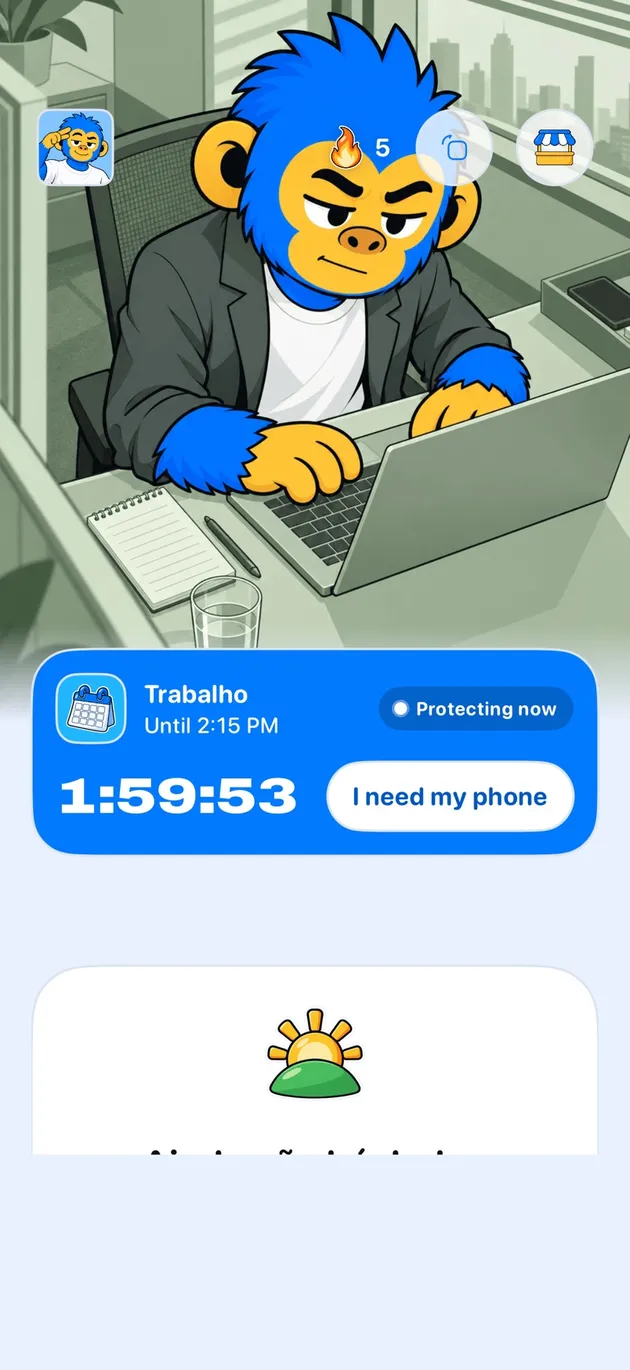
Offimo puts a pause right at the moment you open an app out of habit. You can decide whether to go in, or set up firmer protection ahead of time. And Jeff is with you along the way.
Offimo doesn't rely on you remembering to set limits or having the willpower to follow them. Instead, it creates a moment of awareness every single time you try to open a distracting app.
A peer-reviewed study of the one sec app found 57% fewer openings of the chosen apps after six weeks. The key is interrupting the automatic behavior, not just setting time limits.
Source: Grüning, Riedel & Lorenz-Spreen, PNAS (2023), a study of the one sec app
See the full comparison →Stanford University research shows clear evidence that people have self-control problems with smartphone usage, and are at least partly aware of them. People consistently underestimate how much they'll use social media in the future.
The research also revealed that interventions work best for those who need them most: people who felt the most addicted at the start showed the greatest improvement in reducing their usage.
Neurobiological research has identified that phone addiction involves the brain's dopamine system and reward pathways. The same mechanisms involved in other types of addictive behaviors.
Sources: Stanford SIEPR (2020), PMC - Mobile Phone Addiction Review (2024)
There is no timeline that fits everyone. The first difference can show up in the very moment the pause makes you notice you were about to open an app you didn't really want to be in.
Stanford's research on behavioral interventions showed an average reduction of 22 minutes per day in social media use, and the effects were strongest for people who felt most addicted at the start.
The key is consistency. Offimo works by building awareness over time, not overnight transformation. Small, gradual changes lead to lasting habits.
Sources: PMC - Smartphone Screen Time Reduction RCT (2025), Stanford SIEPR (2020)
You get 7 days free to see if Offimo is right for you. After that, it's a yearly subscription that costs less than a burrito a month. You'll see the price in the app before you confirm. It's billed to your Apple Account and renews automatically. If you don't want to continue, cancel in your Apple subscriptions at least 24 hours before the trial or subscription ends.
Yes, if you have an iPhone on iOS 18 or later. On Android? Join the waitlist on the Android page of our site.
You choose which apps to protect and which to leave free. For protected apps, access depends on the mode you picked. Every mode has an emergency unlock for when you really need it.
In pause mode, you can go in. You had the chance to choose. If you need more support, Commitment Mode gives you firmer protection.
No. You pick the hours and days, and the protection repeats. You can also turn it on by location, like when you get to work. Routine changed? Just adjust it.
No. Offimo doesn't see your conversations or the content you open. Your screen time data stays on your iPhone, and sharing anonymous usage data is optional.